
Custom Logistics Software vs. Off-the-Shelf: What Mid-Market Companies Are Choosing

Updated: May 12
There's a moment in the growth of almost every mid-market logistics company where the software that got them here stops being sufficient for where they're going. For companies evaluating logistics software development in the Philippines or elsewhere, the question isn't whether to modernize — it's whether the next step is another off-the-shelf platform or something purpose-built.
It doesn't announce itself dramatically. It shows up as a dispatch coordinator maintaining a parallel spreadsheet because the TMS can't handle split shipments the way they need. A warehouse manager exporting data to Excel every morning to produce a report that the WMS should generate automatically. A fleet supervisor using three separate platforms because no single tool handles their specific combination of vehicle types, routes, and regulatory requirements.
These workarounds are the signal. They mean the off-the-shelf platform has hit its ceiling — and the business is now spending time and money managing around software limitations instead of using software to grow.
Why Off-the-Shelf Logistics Platforms Have a Mid-Market Problem
Generic logistics platforms are designed for the broadest possible market. That's their commercial logic — a WMS or TMS built to serve thousands of customers across dozens of industries and geographies has to make compromises to work for all of them. For early-stage companies with straightforward operations, those compromises are acceptable. For mid-market companies with more complex, specialized, or regional requirements, they increasingly aren't.
Off-the-shelf platforms often impose constraints around scaling and adapting to new use cases — including performance bottlenecks with growing transaction volumes, high costs for adding users or modules, and incompatibility with third-party tools or APIs. Mid-market logistics companies in particular tend to accumulate these constraints faster than smaller operations, because their scale amplifies every friction point.
The global logistics software market reached USD 16.24 billion in 2025, according to recent market analysis, and is projected to nearly double by 2034 — driven largely by demand from companies that can no longer scale operations using fragmented or generic tools. That growth reflects a real and widespread operational problem, not just a technology trend.
The Four Signs You've Hit the Ceiling
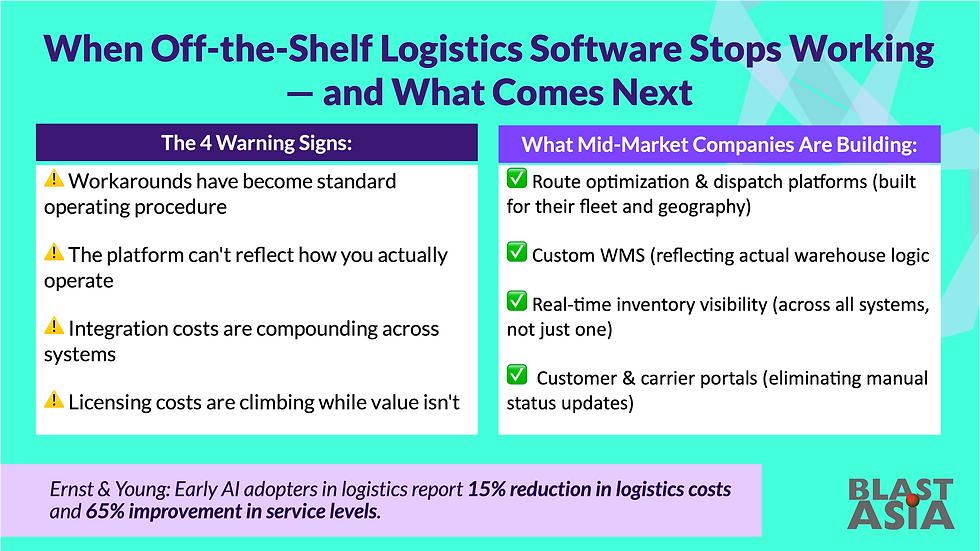
There are four patterns that consistently indicate a mid-market logistics company has outgrown its off-the-shelf software:
Workarounds have become standard operating procedure. When staff have developed unofficial processes — spreadsheet exports, manual re-entry, parallel tracking systems — to compensate for platform limitations, those workarounds are now part of your cost base. They're consuming hours that should go to operational work, and they're introducing the data quality risks that come with manual steps.
The platform can't reflect how you actually operate. Your business has routing rules, exception workflows, customer SLAs, or fleet configurations that don't map to what the platform was designed for. Every time you need to accommodate a customer requirement or operational change, you're asking whether the software can do it — and often the answer is no, or "only with a workaround."
Integration costs are compounding. Mid-market logistics companies typically run multiple systems — ERP, WMS, TMS, accounting, customer portals. When those systems don't communicate cleanly, integration work becomes a recurring cost. Each new platform addition requires custom integration work, and the accumulated technical debt of a fragmented system eventually exceeds the cost of building a unified one.
Licensing costs are climbing while value isn't. Per-seat or per-module pricing on off-the-shelf platforms can look manageable at the outset and become a significant overhead as the company grows. When you're paying for modules you don't use and can't get the ones you need without a costly upgrade, the unit economics of off-the-shelf start to break down.
What Mid-Market Companies Are Actually Building
When mid-market logistics companies do move to custom software, the most common starting points are the operational systems with the highest workaround burden — the areas where staff spend the most time compensating for platform gaps.
BlastAsia's logistics industry practice works with companies building across the full range of operational needs, supported by the Xamun Software Factory pipeline and Xamun's dedicated logistics industry intelligence. The most common custom builds at the mid-market level include:
Route optimization and dispatch platforms — replacing manual or semi-automated dispatch with systems built around the company's specific fleet, geography, and SLA requirements. Early adopters of AI in logistics have reported a 15% reduction in logistics costs and 65% improvement in service levels, according to analysis by Ernst & Young. BlastAsia's Route Optimization Software and AI Fleet Management Apps are purpose-built for this use case.
Warehouse management systems — custom WMS builds that reflect the company's actual warehouse layout, inventory categories, picking logic, and reporting requirements, rather than forcing operations into a generic platform's assumptions. BlastAsia's AI Warehouse Optimization Systems are built specifically for mid-market warehouse operations that have outgrown standard platforms.
Inventory forecasting and visibility — real-time inventory tracking that integrates across warehouse, transport, and customer systems, replacing the fragmented visibility that comes from running separate platforms. BlastAsia's Inventory Forecasting Platforms address this directly.
Customer and carrier portals — web and mobile interfaces that give customers and carriers real-time visibility into shipment status, documentation, and exception handling — without requiring phone calls or email chains to get basic information.
What Custom Logistics Software Development Looks Like at Mid-Market Scale
One concern that consistently comes up when mid-market logistics companies consider custom software is cost. Enterprise custom builds are expensive. But mid-market custom software — especially when built through an AI-native development process — doesn't have to carry an enterprise price tag.
BlastAsia's xDD service builds to a specification derived from the client's actual operational requirements, using an AI-accelerated pipeline that delivers working software in 21 days and iterates every two weeks. The result is purpose-built software at a fraction of the cost and timeline of a traditional enterprise engagement — and without the licensing overhead that compounds on off-the-shelf platforms over time.
For a mid-market logistics company evaluating its options, the relevant comparison isn't "custom vs. off-the-shelf in general." It's "what does this specific piece of custom software cost to build and maintain, versus what are we currently spending on platform licensing, integration work, and staff time managing workarounds?"
That calculation increasingly comes out in favor of custom — especially as AI-native development has made the build timeline and cost substantially more accessible. If you're at the point where the workarounds have become part of the job description, it's worth having that conversation. Let's talk about what your operation actually needs.


Comments