
What Can You Actually Build in 30 Days? A Realistic MVP Scope Guide

Most founders come to their first development partner conversation in one of two states.
The first: a slide deck's worth of features, a full product vision, and a scope that would take a year to build — presented as a 30-day requirement. The second: a rough idea of what the product should do, with almost nothing written down, and an expectation that the development team will figure out the rest.
Neither of these works. And both of them, in different ways, lead to the same outcome — a first build that takes longer, costs more, and delivers less validated learning than it should.
This post is a practical guide to the middle ground: what a production-ready Version 1 actually looks like in a 30-day window, how to decide what goes in and what doesn't, and how to set up your first build so that it gets you to real user feedback as fast as possible.
Start With the Validation Question, Not the Feature List
The most common scoping mistake founders make is starting with what they want to build rather than what they need to learn.
Your Version 1 has one job: to answer the question your users can only answer when they're using real software. Everything in scope should serve that question. Everything that doesn't should be deferred — not because it isn't valuable, but because you don't need it yet to get the answer.
Before you define a single feature, write down the one or two assumptions your entire business model rests on. What has to be true for this product to work? What do you not yet know for certain? That's what your Version 1 needs to test. The scope follows from the test, not the other way around.
What a 30-Day Build Can Realistically Deliver
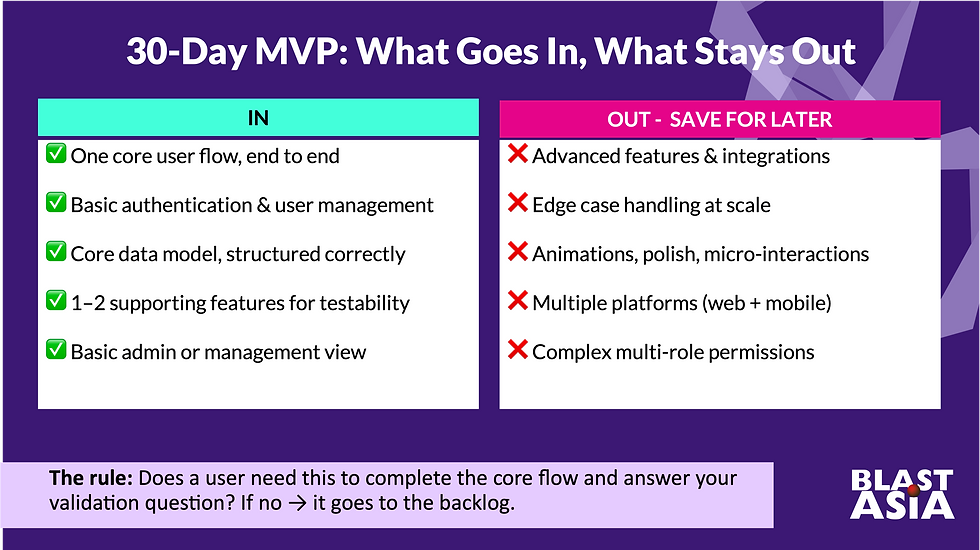
With a well-scoped specification and an AI-native development process — the kind that powers BlastAsia's xDD service and Turnkey Development for startups — a 30-day build can deliver:
One core user flow, end to end. The single most important thing a user needs to be able to do in your product — from arrival to completion — built fully and working in production. Not a prototype. Not a mockup. A real user, on a real device, completing a real task. This is the baseline for everything else.
Basic authentication and user management. Users need to sign up, log in, and have their data associated with their account. This isn't glamorous, but it's what makes the software usable by real people rather than just demonstrable in a controlled environment.
The core data model. The entities your product operates on — whatever the product creates, tracks, connects, or transforms — need to be properly structured and stored. Getting this right at the start is more important than any feature built on top of it.
One or two supporting features that make the core flow meaningful. Depending on what your core flow is, there may be one or two adjacent features that aren't the main event but are necessary for the core flow to be testable in a realistic context. These are the minimum viable context, not bonus features.
A basic admin or management view. For most B2B or platform products, you need some way to see and manage what's happening in your product — user activity, submitted data, status updates. This doesn't need to be sophisticated, but it needs to exist.
What Doesn't Go Into a 30-Day Build
This is where the scope conversation gets difficult — because most of what founders want to include in Version 1 is genuinely useful, just not necessary yet.
Things that don't belong in a 30-day build:
Advanced features that build on the core flow. Notifications, analytics dashboards, integrations with third-party services, multiple user roles with complex permissions — these are all real product features that belong in a later sprint, after the core flow has been validated.
Edge case handling at scale. Version 1 doesn't need to handle every possible user behavior, every error state, or every unusual data condition. It needs to handle the expected case reliably. Edge cases get addressed as they emerge from real usage.
Polish. Animations, micro-interactions, pixel-perfect design across every screen — these belong in a product that has validated its core assumptions. Not before. Users testing a Version 1 are evaluating whether the product solves their problem. They're not evaluating the loading animation.
Multiple platforms simultaneously. If your product needs a mobile app eventually, build the web version first. Get validation on the core flow before committing to the platform expansion.
A Practical Scoping Framework
When you sit down to scope your Version 1, work through this sequence:
Write the validation question. What are you trying to learn from real users in the first 30 days? Be specific.
Define the core user flow. What is the single end-to-end task a user needs to complete to answer that question? Map it out — entry point, steps, outcome.
Identify what's necessary vs. what's nice. For each feature you're considering, ask: does a user need this to complete the core flow? If not, it goes to the backlog.
Write your acceptance criteria. How will you know, at the end of 30 days, whether each piece of scope was built correctly? The answer to this question becomes the brief for your development team.
Explicitly name the backlog. Write down what you're deferring and why. This does two things: it stops good ideas from creeping back into Version 1, and it starts building your roadmap for the sprint after validation.
GitHub's research shows that AI-native development teams complete up to 126% more projects per week compared to traditional approaches — which means a well-scoped 30-day build is achievable, not aspirational. But "well-scoped" is the operative phrase. The development process can be fast. The scoping still requires discipline.
BlastAsia works with funded startups at exactly this stage. BlastAsia's Philippines-based teams run a structured specification process — built on the Xamun Software Factory — that translates a founder's brief into a development-ready specification before a line of code is written. If you're trying to turn a funded idea into a working Version 1 and want help thinking through what belongs in scope, let's talk before you start writing the brief.


Comments